
Stop Slouching! Stand Up Straight! 3 Great Posture Exercises
Did your mother nag you to stand up straight? Do you need to remind yourself today? Want to improve your posture? These 3 posture exercises will help.
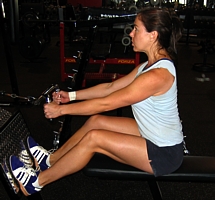 1. Seated Cable Rows: Seated Rows strengthen the major muscles of the back that are keys in maintaining good posture. Most gym goers tend to work the pressing/active muscles of the chest more than they work their pulling/supportive muscles of the back. This can lead to a dominance of the chest muscles causing you to roll your shoulders forward. The importance of strengthening the muscles of the back cannot be over stressed regarding to posture.
How to Perform the Exercise: Sit up tall with the handles held so that the palms of your hands are facing each other. Pull your shoulder blades down and back. Maintain this posture while you pull the handles to your upper abdomen. Then slowly let the handles back out and repeat.
How Often: A standard rule for maintaining proper posture through exercise is to perform two sets of pulling exercises for every set of pressing. For example, if you perform four sets of bench press in a workout session, try to perform six sets of pulling exercises.
Similar Exercises: Dumbbell Rows, Barbell Row, Chest Supported Rows, TRX Rows, and Many Others
 2. Bridges: Bridges Strengthen the glutes as well as provide a stretch for the hip flexors and quadriceps. Because many of us are required to sit the majority of our time at work, we reinforce poor posture. In a sitting position our hip flexors are in a shortened position which means that most people have tight hip flexors. This contributes to a weakening of the glutes and rounding of the lumbar spine.
How to Perform the Exercise: Lie on your back with your legs bent so that your heels are on the floor under your knees. Slowly drive your pelvis toward the ceiling by contracting your glutes and hold the position for several seconds. Slowly release the glutes and allowing your hips to return to the floor.
How Often: Performing two sets of 10 to 15 repititions is a good place to start for most of us. These can be performed two to three times a week. They are a great exercise to throw in on leg or core days. Remember, your core doesn’t just consist of your abdominal muscles!
Similar Exercises: Hamstring Cable Extensions, Supine Glute Sets, Single Leg Bridges
 3. Planks: Planks are an effective exercise for strengthening the muscles of your core. They target the abdominal muscles, muscles of the legs and shoulders, and muscles of the back. They are a simple exercise that can improve your posture tremendously by teaching you how to activate your core.
How to Perform the Exercise: Lie face down on a mat resting of your elbows. Push off the floor, raising yourself up onto your toes and elbows. Keep your back flat, tilt your pelvis and contract your abdominals to prevent sagging of the hips. Hold for as long as you can maintain good form(keep your hips from sagging) and build your endurance.
How often: You can perform planks two to three times a week. These are great posture exercises and should be thrown in on any day you perform core specific exercises. Try holding them for as long as you can. Challenge Yourself!
Similar Exercises: Side Planks, Planks on Swiss Ball, Incline Planks, and Decline Planks.
Want to incorporate more posture exercises like these into your workout routine? Our personal trainers can help! Just contact our office or leave us a comment on this post and we’ll be glad to help.
To get more tips like these, just follow Baudry Therapy on Twitter or like Baudry Therapy on Facebook.
Posted by: Garrett Bludau
 Lie on your back with your knees bent and feet hip distance apart. Place your fingertips just inside your hips so they are resting on your abdomen. Use your abdominal muscles to pull your belly button towards your spine. If you are doing this properly you should feel the muscles underneath your fingertips tighten.
 Lie on your stomach with your head off the edge of the table. Squeeze your shoulder blades together and perform a chin tuck lengthening the back of your neck.