
Postural Exercises for the Runner
Typically, when we discuss injury or injury prevention as it relates to running our focus is mainly on the lower extremities. However, what happens in the upper body is equally as important. Incorporating shoulder, neck and upper back exercises in your post-run stretching and general strengthening routine, can enhance not only your running performance, but also your overall posture and function in everyday activities.
As your distance increases, you are spending more time in the running-type posture, with shoulders slightly rounded head tilting forward and arms swinging repetitively. The problem with this body position is that is places undo pressure on the top of the shoulder and compromises mobility in the neck. As a result, some of you may have noticed intermittent discomfort in your neck or shoulders after a long run.
Below, I have listed some exercises that will help remedy this problem. As we have discussed in the past with lower extremity injuries, the focus of these exercises is to strengthen the areas that are weak and lengthen the areas that are tight. As is the case with most runners (and the general adult population) the anterior muscles of the shoulder and chest have a tendency to become short and tight. The muscles between the shoulder blades tend to become long and weak.
The following exercises are designed to tackle both of these issues and enhance your postural strength for running and everyday life.
 Pectoral Stretch
Use a foam roller or large rolled up beach towel to help stretch out your pectoral muscles
Place the roller along the spine supporting the head. Bring arms out to your side with palms facing the ceiling. Relax and hold this position for 3-5 minutes.
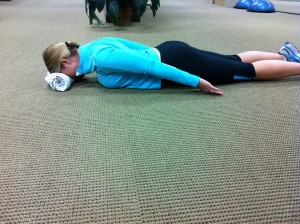 Prone Shoulder Blade Squeezes
Lie on your stomach with arms by your side, supporting your forehead with a towel roll. Bring your shoulder blades down in the back and squeeze them together. Hold 5-10 seconds each and repeat 10 times
 Side-lying Trunk Rotation
Lie on your side with knees bent up towards your chest. Rotate your trunk reaching your arm towards the wall behind you. Hold for 15 seconds and repeat 3 times each side.
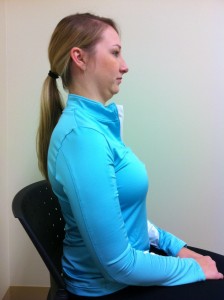 Seated Chin Tucks
Sit in a chair with feet flat on the floor, using good posture. Bring your chin straight back creating a “double chin” appearance. You should feel a stretch in the back of the neck close to the base of the head.
If you have any questions about your running fitness routine, give us a call.
 Training for a marathon not only means putting in the actual hours of training. Training also means preparing your body, nourishing your body, and healing your body. Training professionals must consider factors like muscle balance, strength, flexibility, running mechanics, rest/recovery time, and also be able to handle the bumps and bruises along the way. The longer and harder the competition, the smarter and more efficient the training must be. Having a physical therapist in your corner to handle all of these issues is well worth it.