
Building a strong core: Look beyond sit-ups for optimal results
We have previously written about how gluteal muscle weakness is a source of trouble for many runners. An equally troublesome culprit is lack of abdominal strength. For many years in our schools and even in the military they have used the “sit-up” as a measure by which to grade abdominal strength. And for just as long, people have been using the sit-up to “strengthen and develop” the abdominals. Although the sit-up can be a challenging exercise in many respects, it may not be the optimal go-to exercise in terms of increasing functional abdominal stability.
Traditional sit-ups predominantly use the most superficial layer of your abdominals, the rectus abdominus, along with the hip flexors in order to perform the exercise. Most people in present day society, especially runners, do not need to strengthen the hip flexors. Many of us spend the day sitting behind a desk, or sitting in the car, as a result the hip flexors are already short and tight.
The muscle group that we really want to target when looking to strengthen the abdominals, are the transverse abdominal muscles. These muscles are the deepest of the 4 abdominal muscles groups, and work closely with the multifidi (the small postural muscles in the lumbar spine) and the pelvic floor musculature (the muscles that run from the pubic bone to the tailbone). As a result, improving the strength of this muscle group can help to create a corset of stability in the trunk, providing an optimal foundation from which the body can work.
The first step in strengthening your transverse abdominals is to identify that you are using the correct muscles. Lie on your back with your knees bent, place your fingertips on your abdomen just inside the hip bones. Use your abdominal muscles to pull your belly button towards your spine, (as if you were trying to put on a tight pair of jeans). Make sure you are not holding your breath or sticking out your ribs when you do this.
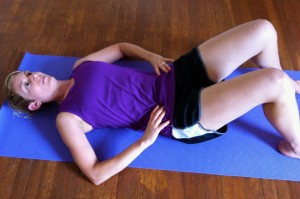 If you are using the correct muscles you will feel a subtle contraction underneath your fingertips. Perform this exercise until you can comfortably hold the contraction for 10 seconds and repeat it 10 times. Once you are confident with this exercise you can begin to include the pelvic floor muscles. The pelvic floor muscles are engaged when you activate the muscles you would use to stop the flow of urine. If you are unsure whether or not you are using the proper muscles place your fingertips on the same spot on your abdomen as you did for the transverse abdominal isometrics. If you are engaging the pelvic floor properly you will feel the same muscles you felt previously under your fingertips tighten. Begin by trying to hold this contraction for 2-3 seconds repeat 10 times. Once you have the hang of it, try to perform the abdominal isometric and the pelvic floor isometric at the same time. This combined isometric exercise is the basis from which we will work to build the rest of the exercises.
For more tips on run training, sports performance, and injury prevention, please contact our office, or respond through the comments section. And for more tips like these just follow Baudry Therapy Center on Twitter, or like Baudry Therapy on Facebook.
Taryn Cohn
Related articles
- Core Knowledge (fitsugar.com)
 Run training involves not only the pre run training but also the post run recovery.